From Keflavík to Reykjavík: The Blue Lagoon and 1.5 Days in Iceland's Capital
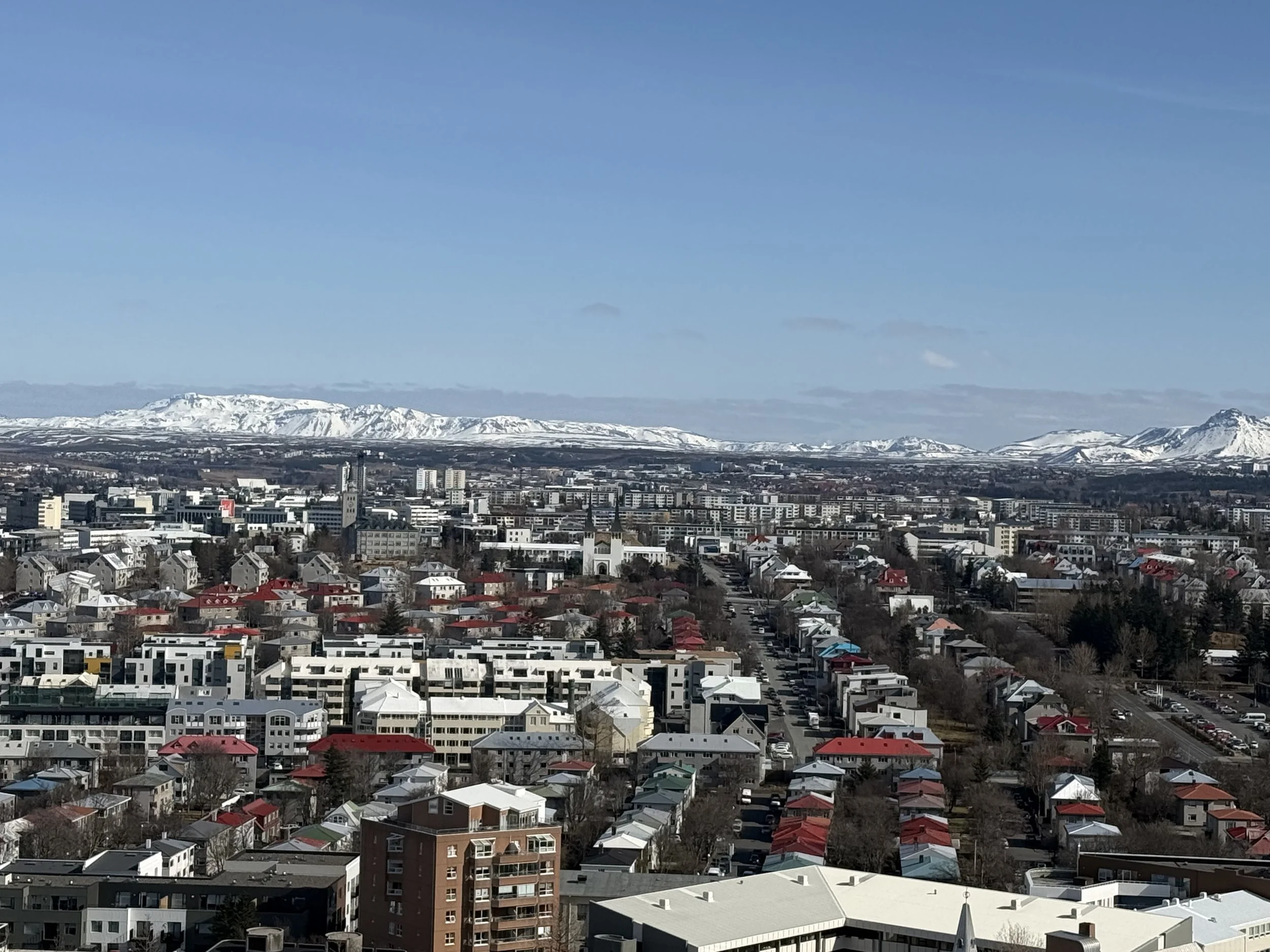
A view of Reykjavik from atop Hallgrímskirkja.
There are two competing instincts when planning the first day of an international trip. One is to make the most of it. You have crossed an ocean, vacation time is limited, and there is an entire country waiting outside the airport. The other is the reality of arriving after an overnight flight, when an itinerary that looked perfectly reasonable from home can become considerably less appealing after several hours on an airplane.
Our first day in Iceland needed to accommodate both.
We landed at Keflavík International Airport at 8:40 in the morning, collected our luggage, took the shuttle to Enterprise, picked up our rental car, and resisted the temptation to immediately drive toward Reykjavík. Instead, we stayed on the Reykjanes Peninsula for brunch before heading to the Blue Lagoon for a noon reservation. Reykjavík would come later that afternoon.
On paper, this could look like delaying the beginning of the trip. In practice, I think it was one of the better decisions we made. The Blue Lagoon gave the first day a structure without asking too much of us immediately after an overnight flight, and placing it between the airport and Reykjavík meant we could experience one of Iceland's most famous attractions without sacrificing half of another day to getting there.
By 2:35 that afternoon, we were ready to begin exploring Reykjavík. We would have the remainder of that day and one full day in the city before leaving for the South Coast, which turned out to be enough time to understand Reykjavík without allowing the capital to consume a road trip that was ultimately about moving through Iceland.
Keflavík Is Not Reykjavík
One of the first things worth understanding when planning a trip to Iceland is that you do not land in Reykjavík. Keflavík International Airport sits on the Reykjanes Peninsula, roughly 50 kilometers from the capital, and that geography matters more than it initially appears to.
Our first task after landing was getting the rental car. We planned roughly 50 minutes between arrival and taking the shuttle to Enterprise, followed by another 20 minutes or so for the rental process. I would preserve that kind of margin rather than building an itinerary around the assumption that everything will happen at the earliest possible moment. Immigration, baggage, rental-car shuttles, and paperwork are not particularly interesting parts of a trip, but pretending they do not require time is an easy way to make the first morning unnecessarily stressful.
There was another reason we did not immediately head for Reykjavík. Our Blue Lagoon reservation was at noon, and the lagoon is much closer to Keflavík than it is to the capital. Driving into Reykjavík first would have meant traveling east only to come back toward the Reykjanes Peninsula and then returning to the city again afterward. It would have been possible, but it would have been movement without purpose.
Instead, we had brunch in Keflavík.
That gave us something useful between collecting the car and our Blue Lagoon reservation. More importantly, it kept us geographically where we needed to be. After an overnight flight, sitting down for an actual meal also sounded considerably better than beginning the trip with a hurried snack in the car.
This is the kind of decision that rarely appears among the highlights of an itinerary, but it determines how the highlights feel. Our first morning was not airport, car, rush, attraction. We had time to arrive.
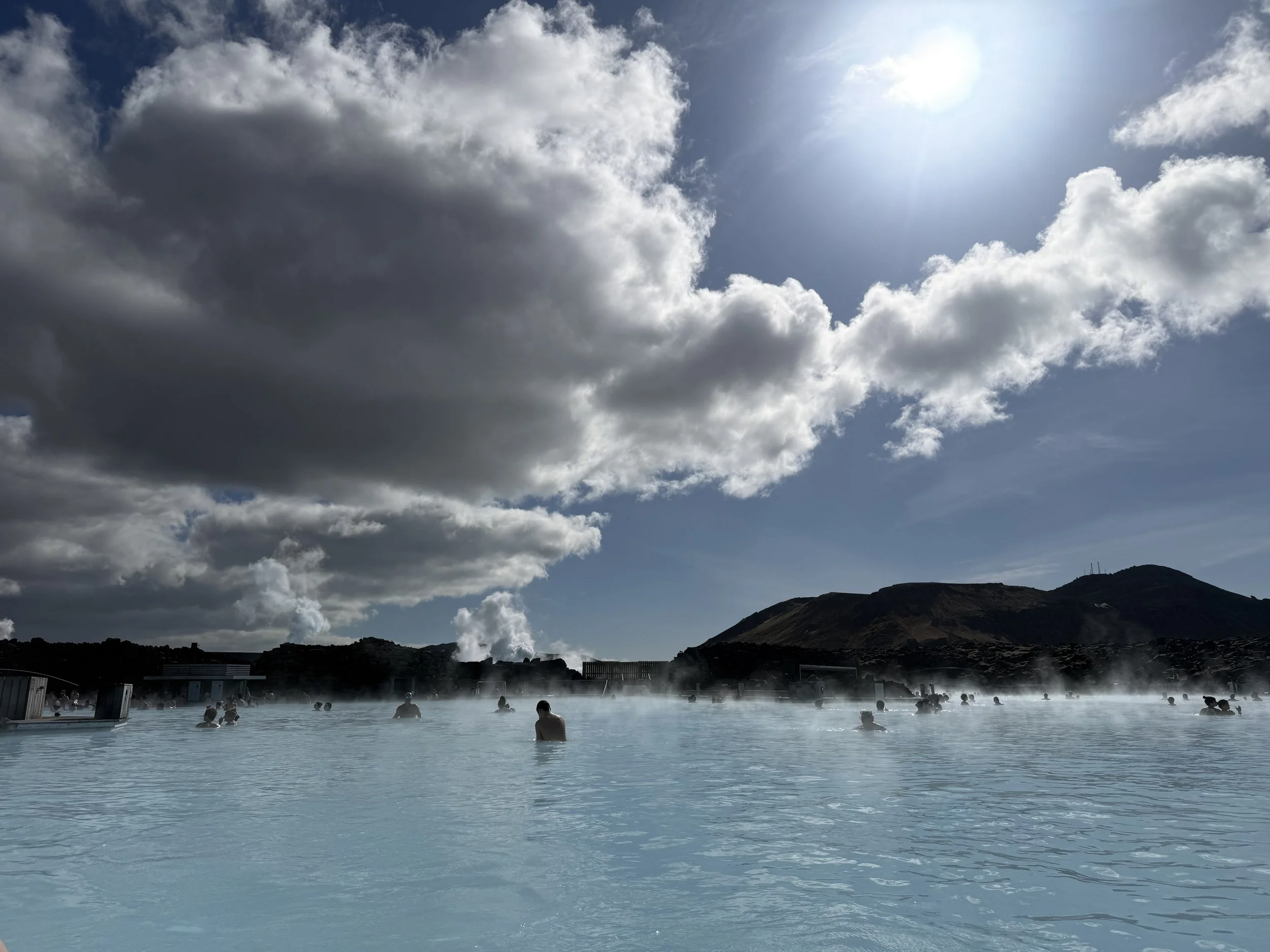
Our blue lagoon experience was wonderful. It was a calm and relaxing way to start the trip.
Should You Go to the Blue Lagoon Straight From the Airport?
If the Blue Lagoon is part of your Iceland plans, there is a strong logistical argument for visiting it on either your arrival or departure day. It sits on the Reykjanes Peninsula between the airport and Reykjavík, so incorporating it while you are already in this part of Iceland avoids a separate trip from the capital later.
For us, arrival day made the most sense.
After brunch in Keflavík, we had about a 25-minute drive to the Blue Lagoon for our noon reservation. That timing gave us a comfortable buffer after the flight without creating several empty hours to fill. It also meant that our first substantial experience in Iceland was not a museum, walking tour, or long drive. We were getting into geothermal water.
There is something particularly well suited about that after an overnight flight.
The Blue Lagoon is hardly an undiscovered Icelandic experience. It is one of the country's most recognizable attractions, and its popularity means it sometimes gets dismissed as overly touristy. I do not think popularity by itself is a particularly useful reason to avoid a place. The better question is whether the experience fits the trip you are trying to build.
For us, it did, especially in this position.
Had we placed the Blue Lagoon in the middle of our road trip, it would have required us to organize part of a day around returning to the Reykjanes Peninsula. On arrival morning, we were already there. Our luggage was in the rental car, we had not checked into our Reykjavík Airbnb, and we did not have another part of the country competing for the time.
The geography made the decision.
I would be more cautious about this plan if the flight arrived much later, if you know you do not function particularly well after overnight flights, or if your arrival schedule is tight enough that a delay would threaten the reservation. The point is not that everyone should go directly from KEF to the Blue Lagoon. It is that if you are already planning to visit, arrival day can turn airport logistics into part of a coherent route rather than treating the morning as something to get through before the trip begins.
The Blue Lagoon as a Transition
There was also something useful about beginning Iceland this way that had nothing to do with efficiency.
Air travel compresses geography. You leave one airport, sit in a metal tube for several hours, and emerge somewhere that is supposed to feel different. Your body has traveled thousands of miles, but your mind has mostly experienced terminals, security lines, airplane seats, and baggage claim.
The drive across the Reykjanes Peninsula begins correcting that.
The landscape outside Keflavík is the first indication that Iceland is going to look different from the place you left. Then the Blue Lagoon introduces another element that will become increasingly important as you travel around the country: the geology beneath all of it.
I would not pretend that visiting the Blue Lagoon is equivalent to discovering some remote Icelandic hot spring. It is a highly developed experience. But that did not make it a poor introduction to the country. In our itinerary, it functioned almost as a transition point between arriving in Iceland and beginning to travel through it.
By the time we showered, changed, and got back into the car, the overnight flight felt farther away.
Reykjavík was next.
Driving Into Reykjavík
The drive from the Blue Lagoon to Reykjavík takes roughly 45 to 50 minutes under normal conditions, which put us in the city around the middle of the afternoon. We had planned to begin exploring at approximately 2:35, although I would treat that time as a target rather than an appointment. Arrival days are exactly where an itinerary needs room to absorb delays.
We had only about a day and a half in Reykjavík, so the temptation could have been to immediately start collecting landmarks. Instead, I think Reykjavík works particularly well when explored on foot and in a loose sequence. Many of the central sights are close enough together that you do not need to experience the city as a series of individual destinations.
That compactness is one of Reykjavík's advantages for a short stay. Hallgrímskirkja, Rainbow Street, Tjörnin, the Old Harbor, Harpa, the Sun Voyager, and Laugavegur can all be connected into a walk of roughly 2.5 miles. Allowing time to actually go inside places, stop for coffee, visit a museum, and wander turns that into several hours rather than a race across downtown.
With only an afternoon on our first day, though, I would not try to complete the entire route immediately. The full day tomorrow gives you time for that.
The first afternoon is better used for getting oriented.
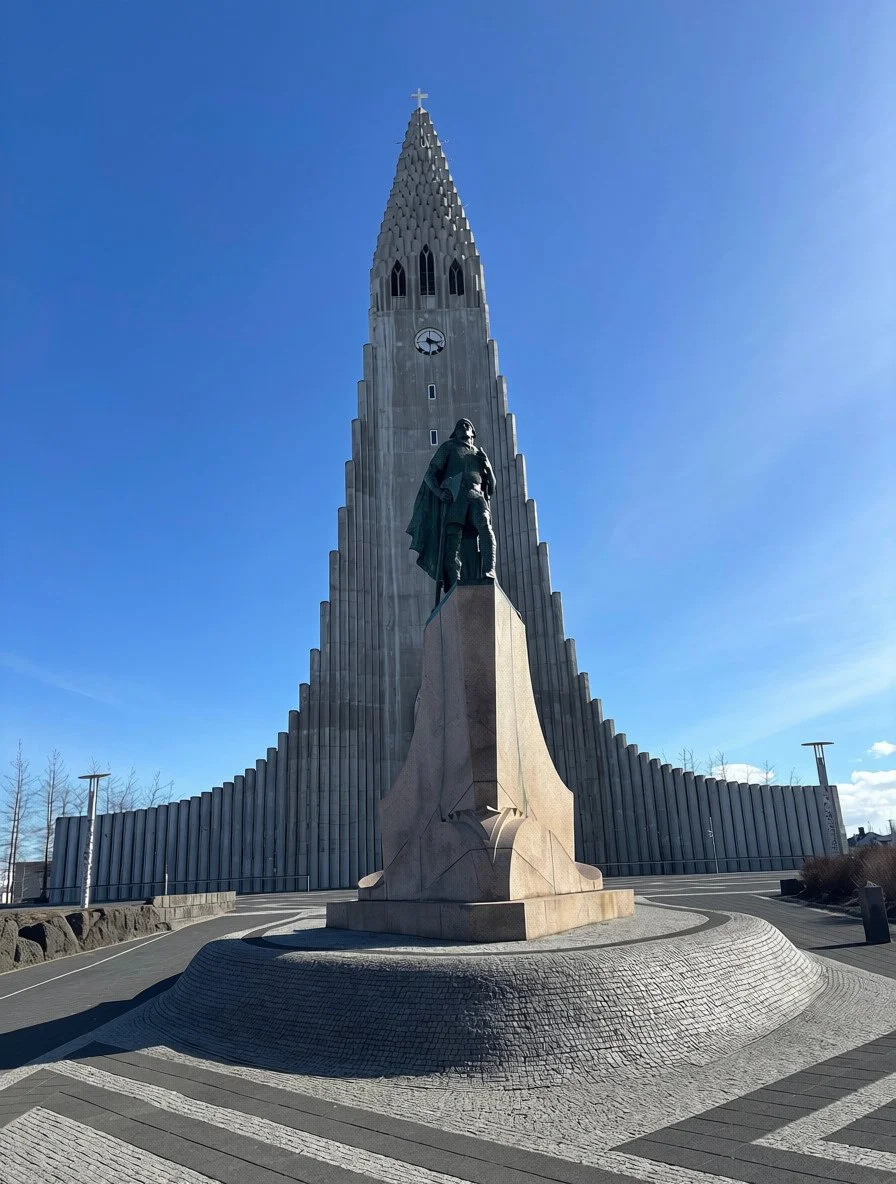
A view of Hallgrimskirkja.
The First Afternoon: Learn the Shape of Reykjavík
Hallgrímskirkja is a useful place to begin because the church does something particularly valuable when you have just arrived in an unfamiliar city: it gives you perspective.
Its architecture was inspired by the basalt formations found throughout Iceland, making the building feel connected to the landscapes we would encounter later in the trip. More immediately useful, however, is the view. From the tower, Reykjavík becomes comprehensible. You can see the colorful roofs spreading toward the water, the harbor, and the mountains beyond the city. Places that were names on a map begin acquiring direction and distance.
From Hallgrímskirkja, walk down Skólavörðustígur, better known to visitors as Rainbow Street. It leads naturally toward the center of Reykjavík and begins shifting the afternoon away from sightseeing and toward simply being in the city. This is where I would allow the itinerary to loosen. There are shops, cafés, restaurants, bookstores, and side streets worth wandering without needing a reason for each turn.
Eventually, work your way toward Laugavegur, Reykjavík's main shopping and restaurant street. Together, Laugavegur and the streets around Rainbow Street provide a good introduction to the scale of downtown. Reykjavík is a capital city, but the center does not feel enormous. After a few hours walking it, the geography begins becoming familiar surprisingly quickly.
That is about as ambitious as I would make the first afternoon.
You have just flown overnight, collected a rental car, eaten brunch in Keflavík, spent time at the Blue Lagoon, driven into Reykjavík, and checked into another place. There is little value in making the evening another endurance exercise simply because the itinerary has available hours.
Find dinner and let the first day end.
Reykjavík Is Worth Experiencing Through Food
A day and a half does not provide enough meals to understand Reykjavík's food scene comprehensively, which makes choosing where to eat another exercise in priorities.
The city offers considerably more than the novelty foods often associated with Iceland. Seafood and lamb are obvious parts of Icelandic cooking, but Reykjavík also has food halls, bakeries, casual restaurants, ambitious Nordic cooking, and an international restaurant scene that feels larger than the city's population would suggest.
For a first evening, I like the idea of staying somewhere around Laugavegur or the Old Harbor rather than driving elsewhere for dinner. You have already spent enough time in transit. Both areas give you multiple options and allow dinner to become part of the evening walk rather than another logistical task.
If everyone wants something different, Reykjavík's food halls can also solve a practical problem without reducing dinner to generic convenience food. Hlemmur Mathöll occupies a former bus terminal near the eastern end of Laugavegur, while Grandi Mathöll sits closer to the harbor. A food hall is particularly useful on a travel day because it allows everyone to make a different decision without requiring another reservation or lengthy meal.
Then there is the Reykjavík hot dog.

The Reykjavik hot dog
Bæjarins Beztu Pylsur has been serving hot dogs since 1937 and has become famous far beyond Iceland. Whether the hot dog itself deserves its international reputation is almost beside the point. It is inexpensive by Reykjavík standards, centrally located, and easy to work into a walk around the harbor. If you want the traditional combination of toppings, order one "eina með öllu," or "one with everything."
Bæjarins Beztu Pylsur has been serving hot dogs since 1937 and has become famous far beyond Iceland. Whether the hot dog itself deserves its international reputation is almost beside the point. It is inexpensive by Reykjavík standards, centrally located, and easy to work into a walk around the harbor. If you want the traditional combination of toppings, order one "eina með öllu," or "one with everything."
Your Full Day in Reykjavík: Walk the City in an Order That Makes Sense
The advantage of having already wandered downtown the previous afternoon is that the full day does not begin with the city feeling completely unfamiliar. Now you can move through Reykjavík more deliberately.
I would start again around Hallgrímskirkja if you did not visit the tower the previous afternoon, or simply begin near Rainbow Street and work downhill. The important part is direction. Reykjavík is compact enough that a walking itinerary should flow through the city rather than repeatedly sending you back across the same streets.
From Rainbow Street, continue toward Tjörnin, the pond beside Reykjavík City Hall. This is a quieter part of the center, surrounded by colorful buildings and an easy place to slow the pace after the more commercial streets. City Hall is also worth stepping into to see the large relief map of Iceland. After spending so much time planning routes on a flat screen, seeing the country represented physically provides a useful sense of the terrain you are about to drive through.
From Tjörnin, it is only a short walk toward one of the best places to add historical context to the trip: the Settlement Exhibition.
The museum is built around the remains of a Viking Age longhouse discovered beneath Reykjavík and focuses on the settlement of the city around the late ninth century. If the rest of your Iceland trip is going to be dominated by landscapes, this is a good moment to establish the human story that exists within them. Iceland is easy to encounter primarily as geology. Spending part of the Reykjavík day learning about settlement makes the towns, farms, churches, and place names you encounter later feel less incidental.
From there, continue toward the Old Harbor.
Let the Harbor Connect the Rest of the Day
The Old Harbor is where the walking route begins turning back toward the water. Fishing and whale-watching boats share the area with restaurants, cafés, and museums, and it is a good place for lunch or coffee before continuing along the waterfront.
From the harbor, Harpa Concert Hall is a natural next stop. Its glass exterior makes it one of Reykjavík's most recognizable modern buildings, but it is worth going inside even if you are not attending a performance. The building responds constantly to the light and weather outside, and its location along the water makes it feel less like an isolated architectural landmark than part of the harbor itself.
Continue east along the waterfront from Harpa and you eventually reach the Sun Voyager, or Sólfar. The stainless-steel sculpture resembles a Viking ship, although it was conceived more broadly as an ode to the sun and to exploration. The mountains across Faxaflói Bay provide the backdrop, and after spending the morning moving through museums, streets, and buildings, the waterfront opens the city back toward the landscape surrounding it.
The entire route from Hallgrímskirkja through Rainbow Street, Tjörnin, the Settlement Exhibition, Old Harbor, Harpa, and the Sun Voyager is only around 2.5 miles of walking. Give it several hours anyway. The point is not the mileage. It is everything you allow yourself to do between the points on the map.
What to Do With the Rest of the Day
This is where I would stop prescribing a universal Reykjavík itinerary.
Once you have completed the central walking route, the remaining hours should reflect what interests you rather than what another list says belongs in the city's top ten. If Icelandic history matters most, the National Museum of Iceland provides a broader account of the country from settlement through the modern period. If you want more context for the landscapes you are about to encounter, Perlan combines exhibits about Icelandic nature with a 360-degree observation deck over Reykjavík.
You could also decide that you have seen enough exhibits.
Reykjavík has a strong café culture, bookstores, street art, shops selling Icelandic design, and enough interesting streets that an unscheduled afternoon is not wasted time. One of the mistakes that is easy to make with a short city stay is assuming that because time is limited, every hour needs a named attraction attached to it.
Sometimes having only a day and a half makes wandering more important, not less. You are not going to know Reykjavík comprehensively. The better goal is to leave with some sense of the place.
Is 1.5 Days Enough for Reykjavík?
If Reykjavík were the primary reason for traveling to Iceland, I would want more time. For a road trip like ours, I think a day and a half is a reasonable balance.
It gives you enough time to see the city's major landmarks without reducing Reykjavík to the airport-adjacent place where you pick up a car. You can walk the center, see Hallgrímskirkja, spend time around the harbor, visit a museum, eat well, and begin understanding the history of the country before encountering more of it on the road.
At the same time, Reykjavík does not consume so much of a weeklong itinerary that the rest of Iceland becomes rushed. That mattered to us because the next stage of the trip would take us east along the South Coast to Vík, then onward toward Höfn before eventually turning north.
I would also repeat the sequence of our arrival day. Landing at Keflavík, staying on the peninsula for brunch, visiting the Blue Lagoon, and then driving into Reykjavík made geographic sense. More unexpectedly, it gave the trip a gradual beginning.
We did not step off the airplane and immediately begin trying to see Iceland. We moved into it.
The airport gave way to the strange landscape of the Reykjanes Peninsula, which gave way to geothermal water, which eventually gave way to Reykjavík's colorful roofs and walkable streets. By the time we left the city for the South Coast, Iceland no longer felt like a destination we had just arrived in.
It felt like a place we had begun to understand.
And only then did we start driving east.
